
You know what your problem is… So why hasn’t anything changed?
Awareness is not the destination.
It's the starting gun.
Here's what actually moves the dial.
You've done the therapy. Read the books. Maybe put your team through a leadership program.
You can name your triggers, cite your attachment style, and trace the pattern back to childhood.
You might even have the LinkedIn certificate to prove it.
And yet. Here you are. Unchanged and wanting something different.
This is the gap most people — and most organisations — are sitting in right now. And it's wider than anyone in the industry wants to admit.
Therapy has become a label we wear rather than a process we go through.
We identify with our patterns instead of doing something about them.
Why Nothing Has Changed
Awareness feels productive.
Talking feels productive.
Workshops, books, courses, self-knowledge — all of it feels like progress.
But none of it requires behavioural risk.
The same pattern runs through organisations. People can understand burnout and still overwork. Understand communication and still react poorly under pressure. Understand toxic patterns and still repeat them.
The brain prioritises familiarity before performance. Even patterns that frustrate you feel neurologically safe because they're known. What’s known feels safer than what’s new — even when it’s not working.
Insight is not the change.
Repeated action under pressure is.
Knowledge and behavioural capacity are not the same system.
PS Perspective
The Problem
We’ve created a generation of highly self-aware people who are still stuck.
Attachment styles. Love languages. Nervous system vocabulary. Awareness has become the endpoint instead of the entry point.
And the system often rewards it.
Therapy can become emotional outsourcing — feeling understood without building capacity. Corporate training does the same: deliver the insight, call it transformation.
But attending therapy isn’t the work. Attending the workshop isn’t the work.
Real change comes from accountability, repetition, and behavioural action under pressure — not just insight alone.
PS In Practice
A client came to PS after years of trauma-focused therapy. He understood his history in detail and could explain exactly why he struggled with depression, avoidance, and shutdown.
But despite all the insight, his life had stopped moving.
As a business owner, he was isolated, exhausted, stuck in rumination, and waiting to feel better before taking action.
At PS, we shifted the focus away from endlessly analysing the past and onto the behaviours keeping the depression alive in the present — withdrawal, inactivity, poor routine, nervous system overload, and avoidance.
We introduced structure, accountability, movement, and behavioural targets outside the session room.
Within months, he experienced more measurable change than he had in years.
Not because he discovered new insight.
Because he started consistently practising different behaviours.
The PS Point
At PS - I am not interested in helping people become more articulate versions of stuck.
I want to identify what isn't working, challenge the patterns maintaining it, and build the behavioural shifts required to move forward.
I use the AAA Approach
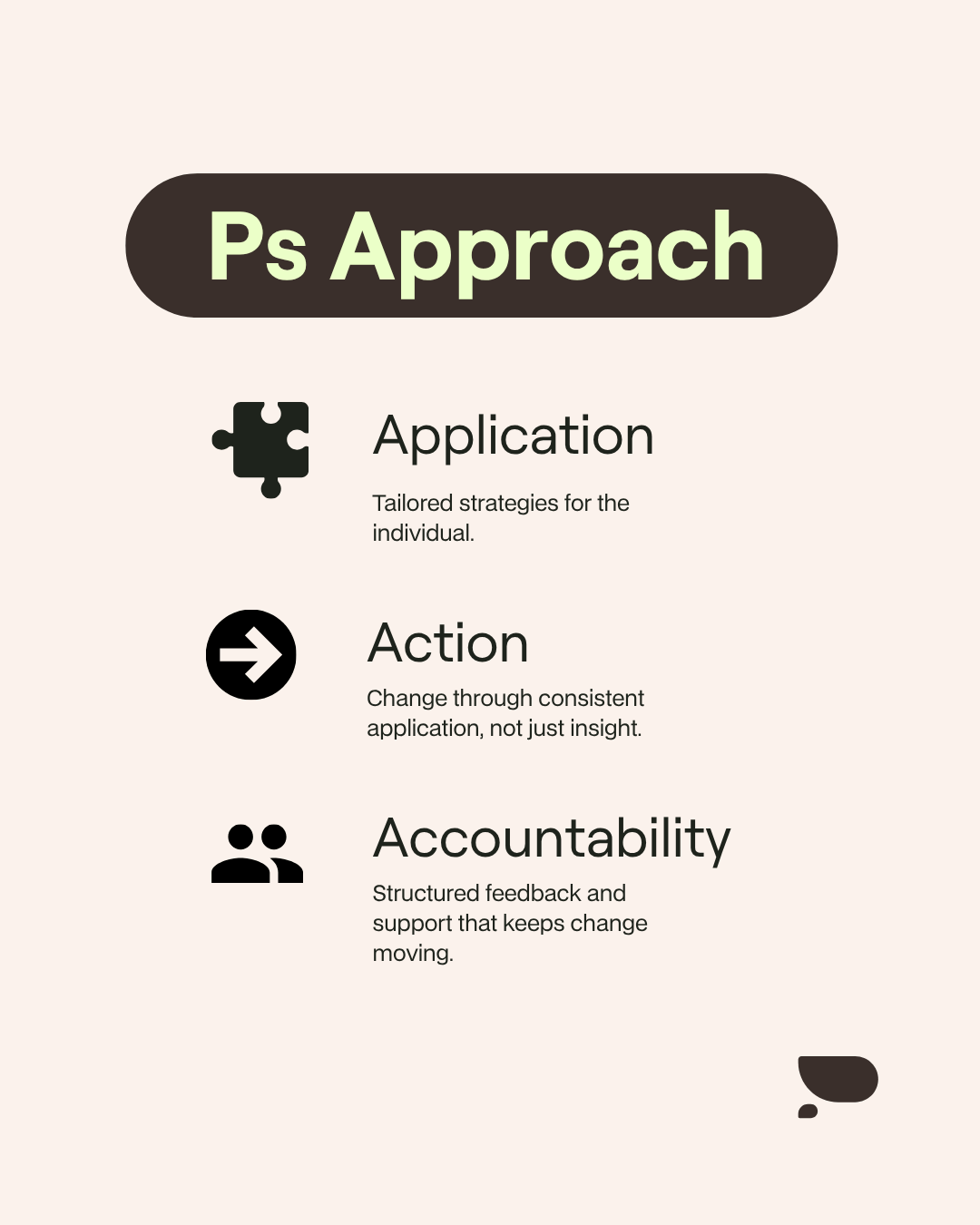
AAA Approach
Applicability
The right strategies for your specific situation — psychological, behavioural, relational, and physiological.
Action
Insight is not the transformation. Repeated action is. The real work happens between sessions.
Accountability
Change collapses in isolation. PS builds accountability through direct feedback, structured review, and ongoing check-ins.
Ready to move from insight to action?
Whether that's personally, in your relationships, or across your organisation — PS is built for exactly that.