
Why Men Don't Ask for Help
Men stay silent not because they're weak.
It's because the model is.
We've defined "getting help" as: talk more, open up, be vulnerable. Then we act surprised when men don't engage. Worse - we label men who won’t access emotions the same as a woman as “toxic”.
Under pressure, most men don't process that way. They move. They solve it. They contain. When help feels like exposure instead of capability, they opt out.
They don't fail the system. The system fails them.
What is the data actually telling us?
4× Male suicide rate relative to women in Australia
40% Less likely to seek mental health support
75% Of all suicides in Australia are male
PS Perspective
The Problem
The standard of care wasn't built for men
The standard model works for some men — the emotionally attuned, the verbally expressive. They exist. But they're not the majority.
And the cultural conversation isn't helping. "Toxic masculinity" presents men with a binary: be toxic, or be more like women. When the message is "the way you're wired is the problem" — men don't lean in. They leave. And we've mistaken that for stubbornness when it's actually a rational response to being told you're broken by design.
For most men, the problem isn't that they don't know how to feel. It's that we're asking them to access it the wrong way.
Men are different. Not worse. Not broken. Biologically, anthropologically, neurologically different. A system built around one way of processing was always going to leave most of them behind.
BIOLOGICALLY
Different stress chemistry - Testosterone changes how threat and help-seeking feel in the body.
ANTHROPOLOGICALLY
Different bonding patterns - Male connection is built through shared activity — not verbal disclosure.
NEUROLOGICALLY
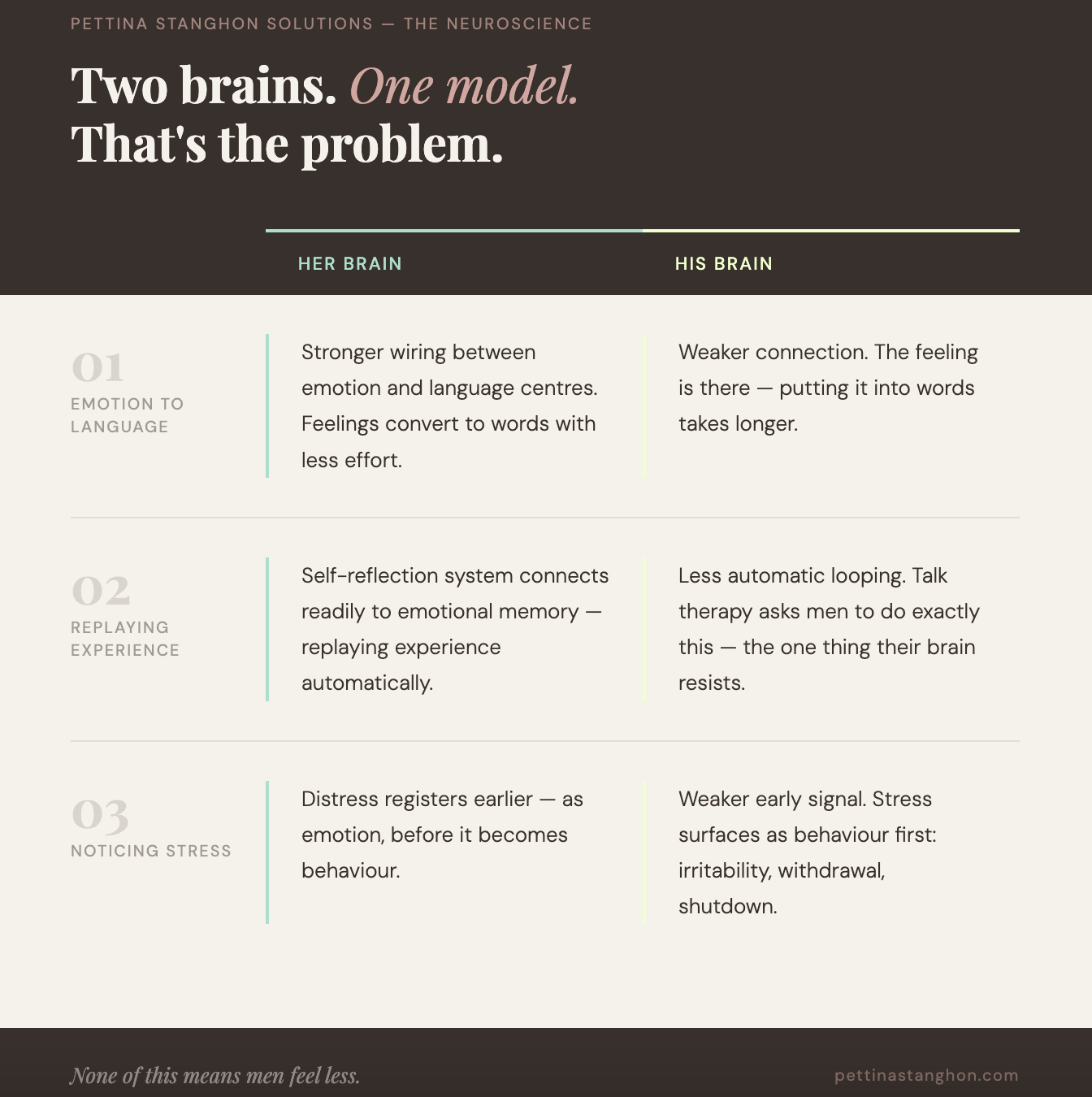
Different processing - The male brain handles emotion differently. Standard therapy asks men to do what their brain resists most.
BIOLOGICALLY
Picture a man who knows something is wrong. He feels it. And yet — he says nothing. Keeps moving. That's not denial. That's his nervous system doing its job.
Men and women handle threat differently. A woman's stress response drives her toward connection. A man's drives him toward action, control, or silence. This isn't socialisation. Oxytocin behaves fundamentally differently when testosterone is in the picture.
Testosterone orients men toward status and competence — as biological defaults. When that's threatened — including by asking for help — the brain responds as it would to any threat. Amygdala activated. Cortisol up. Body on alert.
Reaching out doesn't feel like relief. It feels like risk.
NEUROLOGICALLY
Our brains are different. What a woman is wired for is not the same as for a man.
None of this means men feel less. It means the standard model of care was designed for a brain that processes differently.
ANTHROPOLOGICALLY
Men talk. They connect. Just not the way we've decided talking should look.
Male bonding was never built around processing feelings in a circle. It was built around shared purpose and shared silence — the hunt, the fire, the field. Connection happened through doing, not disclosing. Side-by-side activity lowers cortisol, removes the pressure of direct eye contact, and creates the conditions for real conversation. At PS, walk-and-talk isn't a workaround. It's the method.
The PS Point
The most common thing I hear:
"No matter what I try, it's going to be wrong. So I've stopped trying."
That's not weakness. That's a threat response. Most men don't need more courage to ask for help — they need someone who doesn't require them to perform vulnerability to access it.
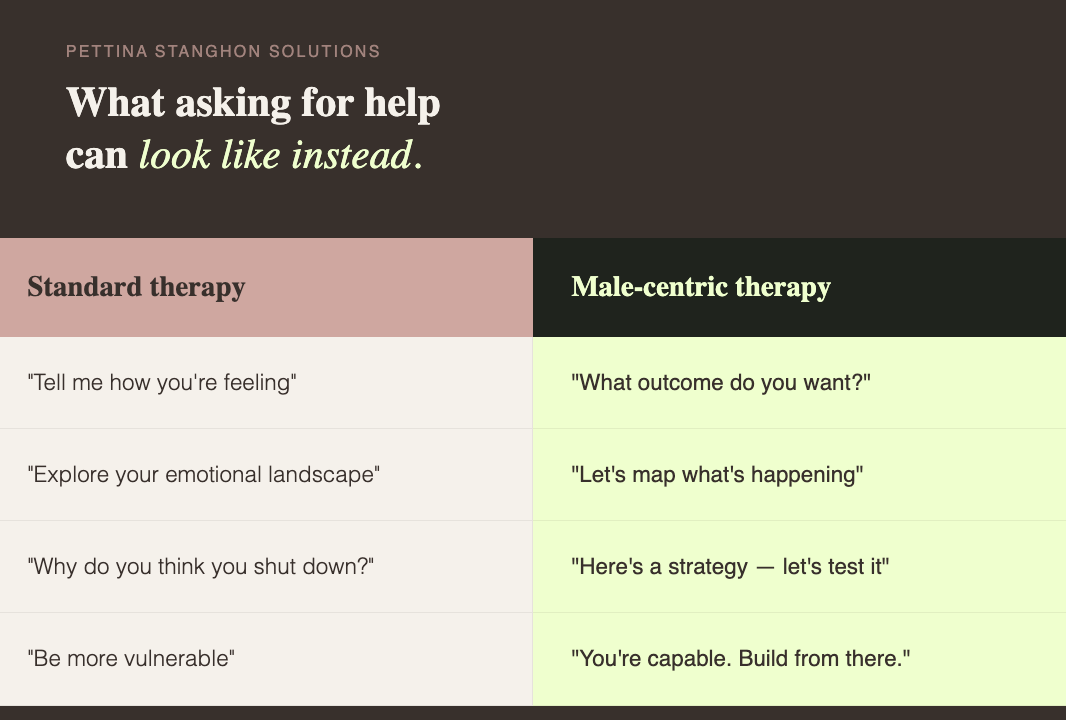
The work is structured and analytical — what's happening, what's driving it, what changes. Progress is defined by you, not by how well you articulate your inner world. You're not here because you're broken. You're here because something isn't working and you want a framework to fix it.
That reframe — from weakness to strategy — is what makes it possible for men to ask for help.
Learn more:
Watch: Chris Williamson and Dr John Barry - Does Psychology have a negative view of masculinity?
Help built for how you’re wired.
Structured. Outcome-focused.