
Relationships will make - or break you.
Work on relationships for a better quality of life.
Think about the most significant moments of your life.
The ones that shaped you. The ones that broke you open. The ones that changed what you believed was possible.
Every single one happened in relationship.
Not in a journal. Not in a meditation. Not in a podcast. In relationship — with another person, or with an experience that changed how you related to yourself.
This is not a coincidence. It is how human beings are built.
You do not exist as an individual. You exist in relationship.
Why Most Problems Are Relational, Not Personal
We are raised to see our lives as individual projects.
Work harder. Think better. Fix yourself.
The personal development industry has built an empire on this idea.
But many of our biggest challenges are not personal. They are relational.
Your relationship with money is not about numbers — it is about what money meant in the house you grew up in. Safety or scarcity. Power or shame. You are carrying that into every financial decision you make today.
Your relationship with conflict, success, failure, and even yourself has been shaped by your experiences and continues to influence your decisions today.
The problem is never just the thing.
It is the relationship you have with it.
All Roads Lead to Relational Work
Every major psychological framework arrives at the same place when you follow it far enough.
CBT examines the beliefs that distort how you interpret relational experiences.
ACT builds the capacity to stay present inside relational discomfort rather than avoiding it.
Family Systems shows how the dynamics of your family of origin are running your relationships right now.
Gestalt works with what is happening in the moment of contact between you and another person.
Different roads. The same destination.
Each method can help you understand the pattern.
Only changing your relationship from WITHIN the relationship can change it.
The Psychology of Change: Why you can’t do it alone
The parts of you that need the most work don't show up when you're alone. They show up with other people — specifically the ones who push your buttons.
You don't learn patience in quiet reflection. You learn it with a child testing every limit. You don't understand your relationship with conflict by thinking about it. You find it inside the conversation you've been avoiding.
The science shows that in genuine human connection, brain activity synchronises, heart rates converge, and nervous systems regulate. This doesn’t happen in isolation — no matter how much you reflect, journal, or meditate (Lettieri, 2026).
This is why 300+ therapy studies (Flückiger et al., 2018). reach the same finding: the strongest predictor of change is not the method. It is the quality of the human relationship inside it.
Why AI Can't Replace Human Connection
Social media promised connection. AI now offers something that feels similar: a presence that listens, reflects, and validates.
The problem is that growth requires more than reflection.
It requires friction. Challenge. Perspectives you did not choose.
AI can reflect your story back to you. It cannot truly challenge it.
And without challenge, reflection becomes a holding pattern rather than change.
PS Point: Change happens in relationship
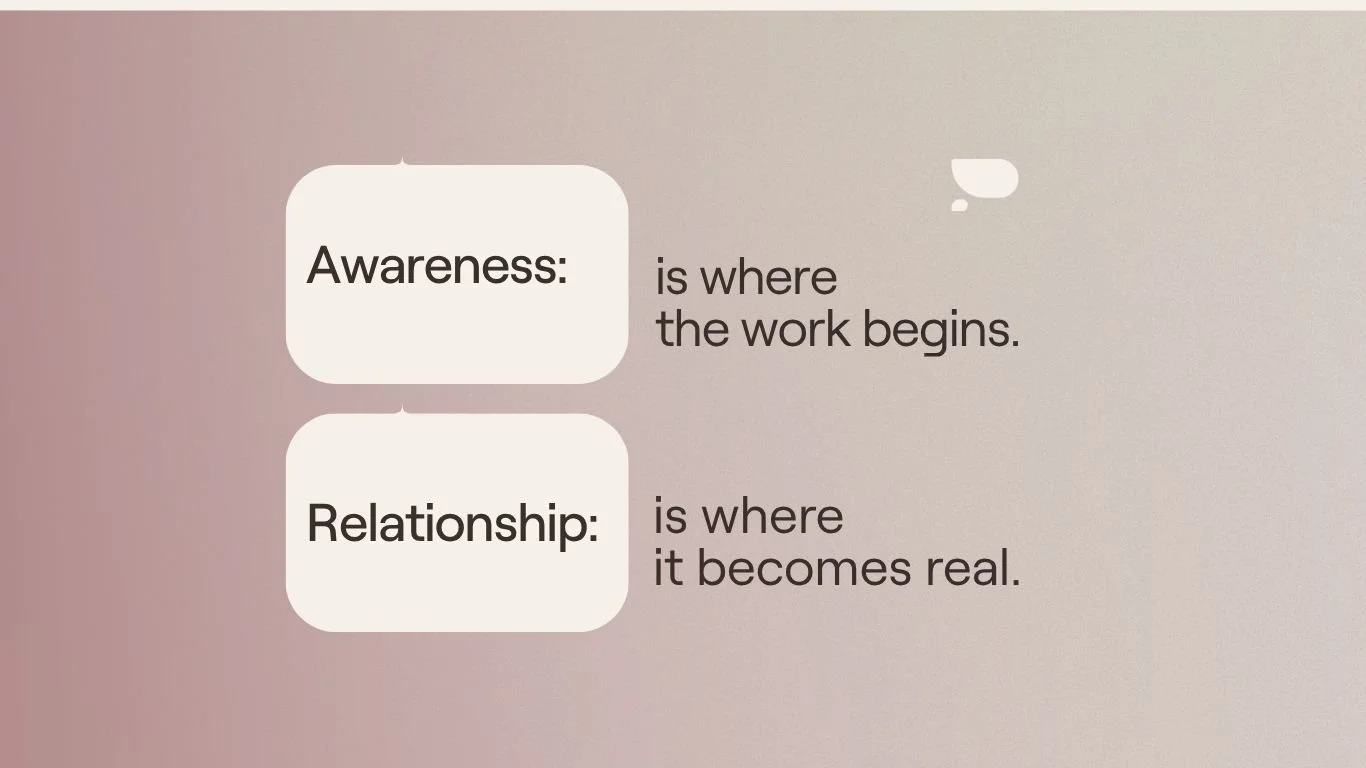
As I wrote in the last Bulletin, self-reflection matters. It is where awareness begins.
But awareness is not change.
Many people can explain exactly why they think, feel, and behave the way they do. Yet the same patterns keep showing up.
Because change does not happen in isolation. It happens in relationship.
And relationship is not just with other people. It is your relationship with your work, your emotions, your habits, your uncertainty, your partner, and the situations life puts in front of you.
This is where the real work lives.
It requires curiosity — the willingness to look honestly at what you bring to the dynamic, not just what the other person, situation, or feeling is doing.
And it requires tenacity — the willingness to keep showing up, tolerate discomfort, repair when things break, and practise new ways of responding.
The goal is not to feel better when you are alone.
The goal is to show up differently in the relationship, situation, or feeling that used to knock you off course.
Exercise:
Think about a person, situation, feeling, or habit that regularly frustrates you.
Ask yourself:
What is my current relationship with this?
How do I typically respond when it shows up?
What is one small way I could respond differently this week?
The goal is not to think differently.
The goal is to practise relating differently.
Because lasting change comes from changing your response,
not just understanding the pattern.