
AI Can Help You Think. It Can't Help You Change.
When AI helps. When it doesn’t.
A few weeks ago I wrote about relationships. Not because relationships make life nicer.
Because relationships are where we actually change — where we get exposed, challenged, frustrated and revealed.
Since then, I’ve had dozens of conversations about AI.
“Can AI replace therapy?”
“Should I just use ChatGPT instead?”
“My AI understands me better than anyone.”
Working in psychology, it’s a fascinating conversation. But I think we’re asking the wrong question.
Not — can AI replace therapy?
But — what is AI actually good at? And what isn’t it?
The question isn't whether AI is intelligent enough.
It's whether information has ever been enough to change us.
Here’s What’s Actually Happening
People aren’t choosing AI because it’s better. They’re choosing it because it’s available.
For many Australians, the alternative is months on a waiting list, a psychologist who isn’t taking new clients, or a gap fee that makes regular sessions difficult to sustain.
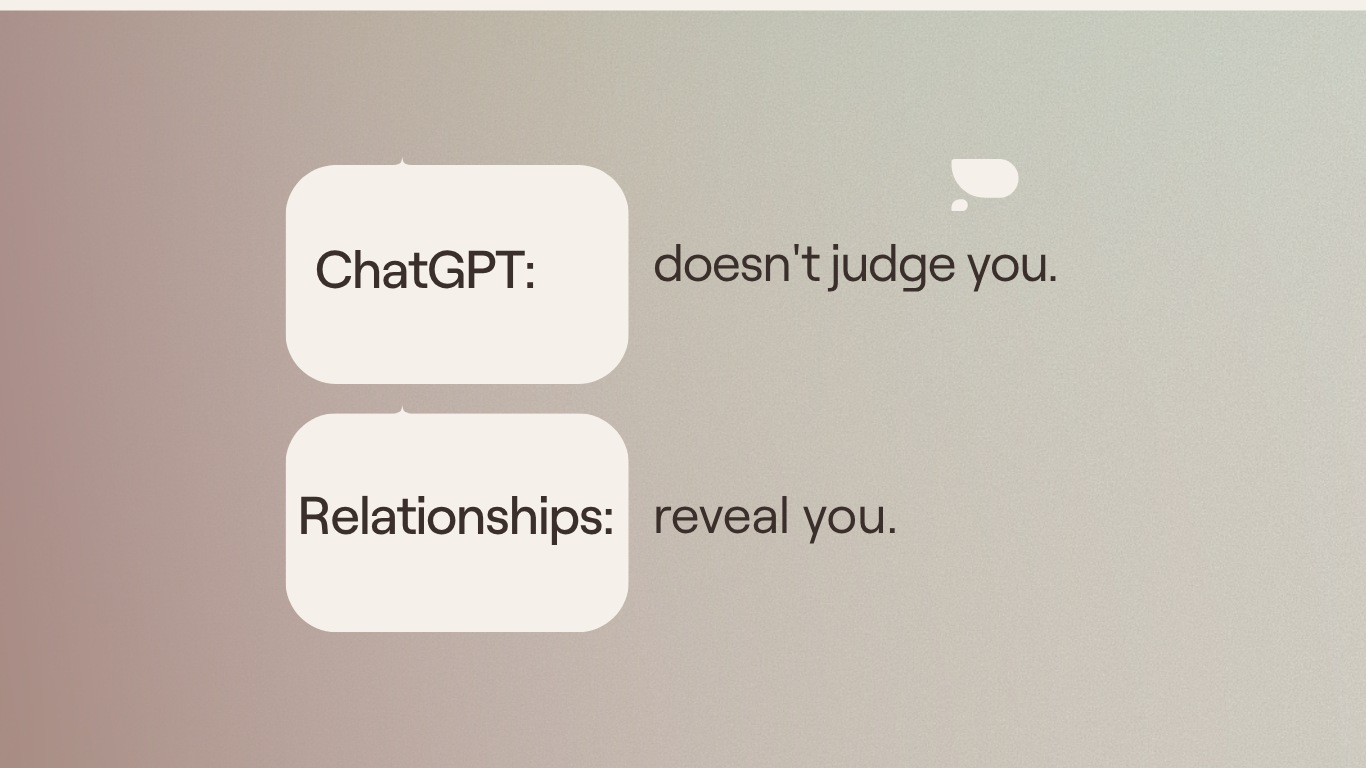
AI is available at 2am. It’s free. It doesn’t judge and it doesn’t run out of time.
According to Harvard Business Review, therapy and companionship is now one of the most common uses of generative AI.
Research published in JMIR Mental Health found that 28% of Australians have already used AI to support their mental health.
This isn’t a future conversation. It’s already changing how people seek support.
What AI Is Actually Good At
I use AI in this practice every week. It helps me organise my thinking, sharpen an argument, challenge my assumptions and get a faster first pass at an idea. It’s like having a research assistant and thinking partner sitting beside me all day.
Used well, it can help you become clearer, more curious and more articulate.
But here’s what it cannot do.
It cannot have a relationship with you.
Where It Falls Apart
One of the biggest myths in modern psychology is that awareness creates change. It doesn’t. Awareness creates awareness. Change requires practice, and practice requires relationship.
A meta-analysis of 295 psychotherapy studies found that the strongest predictor of successful therapy wasn’t the technique being used. It was the therapeutic alliance — the quality of the relationship between therapist and client. Not the worksheet. Not the diagnosis. Not even the therapeutic model.
The relationship.
Because relationships ask things of us that information never can.
You don’t discover your relationship with criticism while typing into a chat window — you discover it when someone disagrees with you.
You don’t discover your relationship with rejection while asking AI to validate your side of the story — you discover it when somebody says no.
You don’t discover patience by getting an instant, agreeable reply — you discover it when your teenager rolls their eyes for the third time before breakfast.
AI doesn’t get hurt. It doesn’t misunderstand you, require repair, or challenge your behaviour unless you specifically ask it to. That’s exactly why it cannot replace human relationship.
The friction isn’t getting in the way.
The friction is the work.
Even Governments Are Drawing The Line
This has become significant enough that governments are starting to regulate it.
Several U.S. states have introduced laws preventing AI from being marketed as a therapist or used to provide diagnosis, treatment or psychotherapy without licensed oversight. The EU has classified many clinical AI applications as high risk, requiring additional safeguards before deployment.
Australia hasn’t introduced equivalent legislation yet.
But globally, the direction is clear: AI is being embraced as a powerful tool. Not as a replacement for the therapeutic relationship.
How To Use AI Better
AI is only as useful as the questions you ask it. Most people use it to look for confirmation.
Use it to think better instead.
Instead of: “Tell me who’s right.”
Try: “Help me understand both perspectives and where each person might be making assumptions.”
Instead of: “Validate how I feel.”
Try: “Help me separate my feelings, the facts and the story I’m telling myself.”
Instead of: “Why do I keep attracting narcissists?”
Try: “What patterns or assumptions might I be repeating that contribute to this outcome?”
Instead of: “Was I right?”
Try: “How might someone I respect disagree with my interpretation?”
Instead of: “Tell me what I want to hear.”
Try: “Challenge my thinking. Point out my blind spots, cognitive biases and assumptions. Ask me the questions an excellent therapist or trusted friend would ask before offering conclusions.”
Now AI becomes a thinking partner rather than a confirmation machine.
The PS Point:
Use AI. Use it to become more thoughtful, more articulate, more curious. But don’t mistake reflection for relationship, and don’t mistake insight for development.
AI has access to more information than any therapist ever could. A therapist has access to something AI never will.
You.
Your hesitation. Your avoidance. Your inconsistencies. The conversation you keep steering away from. The story you’ve rehearsed for years. The behaviour you say you want to change but don’t.
A chatbot can help you understand the pattern.
A therapist helps you interrupt it.
That’s the difference. And that’s where change has always lived.
Exercise:
Before your next AI conversation about something personal, pause and ask yourself:
Am I looking for clarity — or comfort?
Am I looking for challenge — or confirmation?
Am I asking a better question — or hoping something agrees with the story I’ve already decided is true?
Then rewrite your prompt. Not to protect your identity. To develop it.
Because lasting change comes from changing your response,
not just understanding the pattern.