
Has your self-awareness changed what the people around you experience?
Your goddess archetype can explain you. It can’t act for you.
Goddess archetypes are having a resurgence. Women are using them to explore femininity beyond what they've been told a woman should be. And I can see the appeal.
Aphrodite. Lilith. Athena. Artemis. Kali.
Anger, sensuality, independence, ambition, creativity, strength. Qualities women have often been taught to minimise are suddenly things to recognise, express and even celebrate.
Good. There's value in that. But identifying with an archetype isn't the same as understanding yourself.
Why do you connect with it? Where do those qualities come from? When do they show up? And are they helping you or getting in your way? Some parts of yourself are worth embracing. Others need examining. Some might need changing.
An archetype can give you language for who you are. It doesn't tell you what to do with that information. And that's the part I'm interested in.
What does knowing actually change?
Understanding the pattern is one psychological skill.
Having the capacity to respond differently when it appears is another.
Your relationship doesn’t experience your archetype
It experiences you.
Your relationships are shaped by what happens when you’re angry, rejected, criticised or uncomfortable. Maybe you become defensive, withdraw, over-explain or struggle to apologise without justifying what you did. These are the things the person on the other side of you actually experiences.
An archetype might give you useful language for understanding some of those reactions.
Recognising the fierce, protective part of yourself in Kali, for example, might help you understand why anger comes so quickly when you feel threatened. Identifying with Lilith’s independence might illuminate why autonomy matters so deeply to you, or why closeness can sometimes feel uncomfortable.
That recognition is good. It gives you information you may not have had before.
But then the question changes.
Can you feel the anger without letting it control the conversation?
Can you protect your independence while remaining emotionally connected to somebody else?
Understanding the pattern is one psychological skill.
Having the capacity to respond differently when it appears is another.
The seduction of the explanation
There is a satisfying feeling that comes with finally finding an explanation for ourselves.
That’s why I do that.
That’s the part of me that takes over.
That’s just who I am.
Sometimes that recognition really is a breakthrough. It can create compassion where there was previously shame or confusion.
But explanations can also become very sophisticated hiding places.
An archetype might explain why conflict activates something in you, but it cannot communicate a boundary, repair after an argument or take responsibility when your behaviour has hurt someone.
Those things still require you.
And this is where insight becomes particularly interesting in relationships.
Your realisation might be new to you. The behaviour isn’t new to them
You finally understand why you shut down during conflict. You've connected the dots, found the explanation and had a huge personal breakthrough.
Great.
But your partner has been dealing with you shutting down for three years. What's new to you isn't new to them.
They might appreciate the explanation. They might even have more compassion for why you behave the way you do. But they're still allowed to want something to change.
Understanding why you withdraw doesn't make the withdrawal any less frustrating for the person on the receiving end. It just gives you a better chance of recognising it and doing something differently.
Tell them you need ten minutes instead of disappearing. Stay in the conversation instead of shutting it down. Take responsibility without making your past the reason someone else has to tolerate your behaviour.
And if you're the person on the receiving end, understanding someone's patterns doesn't make you responsible for managing them.
You can have compassion for someone's history and still expect accountability.
Your breakthrough might change how you see yourself. But has it changed what the people around you experience?
Because that's where the real work begins.
Awareness isn’t capacity
This is where psychological adulthood becomes important.
Psychological adulthood isn’t about understanding yourself perfectly. It’s about developing enough capacity that your understanding creates more choice.
Insight can help you recognise the moment an old pattern has been activated. Capacity is what allows you to interrupt what usually comes next.
That space might be very small at first. Perhaps you catch the defensiveness before you say the thing you usually say. You notice the urge to leave the conversation and tell the other person you need ten minutes instead. You recognise that you’re feeling controlled and ask yourself whether a boundary has actually been crossed before reacting as though it has.
This is the less exciting part of self-discovery.
There isn’t always a new label, revelation or explanation.
There is practice.
You don’t need to throw away your Athena.
Keep her.
Just don’t mistake recognising her for having done the work.
The adulting question
Instead of asking:
Which goddess am I?
Try asking:
Now that I understand this part of myself, what am I capable of doing differently because I understand it?
That’s the part I’m interested in.
Because eventually self-awareness should become observable. The people closest to you should be able to experience some difference between what happened before you understood the pattern and what happens now.
Not immediately. Not perfectly.
But increasingly.
The PS Point
Naming yourself isn’t changing yourself.
The language we use to understand ourselves can be incredibly valuable. It can give us context, compassion and a starting point for examining patterns that previously felt automatic.
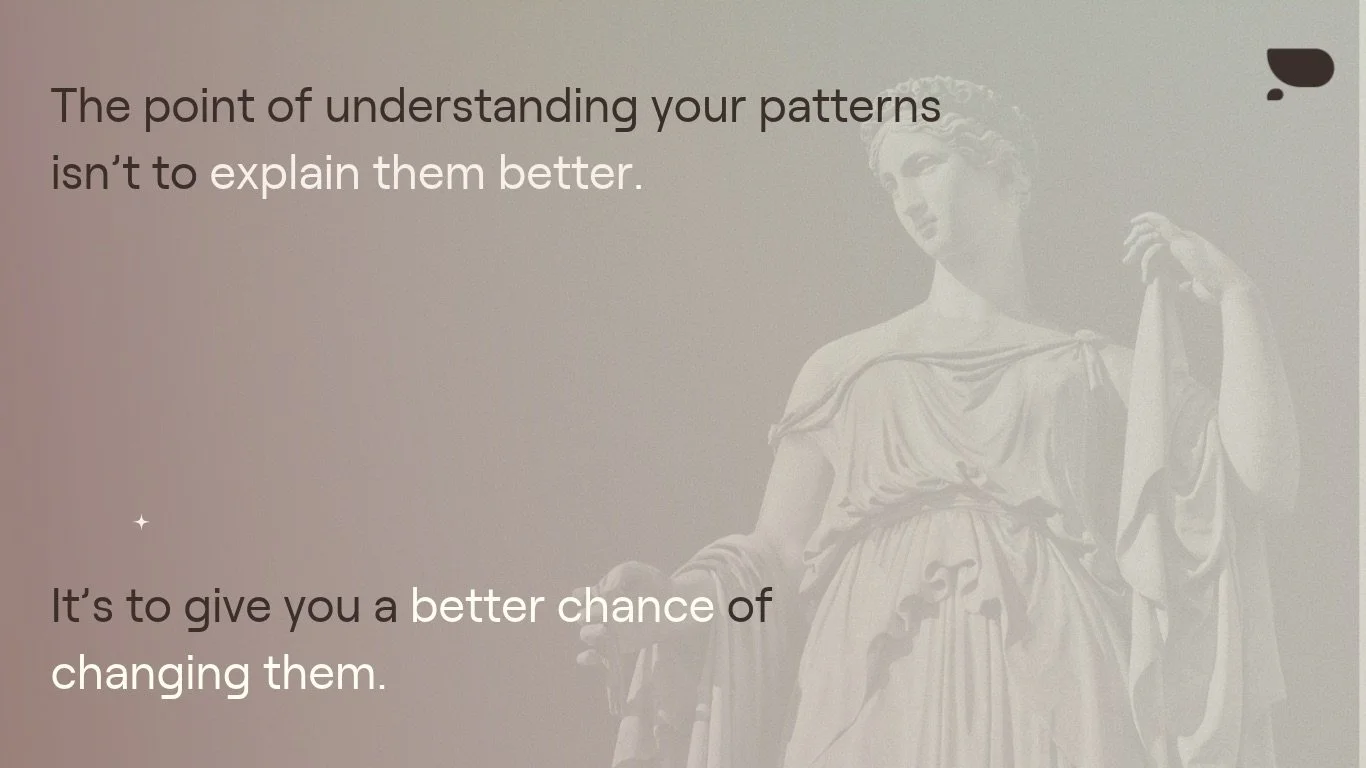
But the goal of self-awareness isn’t simply to become better at explaining why you are the way you are.
It’s to create more choice in what you do next.
Your archetype can help you see the pattern.
Psychological adulthood is what you practise once you can see it.
Exercise
Choose the archetype — or simply the quality within one — that you most recognise in yourself right now.
Aphrodite → sensuality, connection, creativity, desire
Artemis → independence, determination, self-reliance
Athena → intelligence, reason, competence, ambition
Hera → commitment, loyalty, partnership
Demeter → nurturing, generosity, protection
Persephone → sensitivity, intuition, adaptability
Kali → fierceness, anger, power, transformation
Lilith → independence, defiance, refusal to be controlled
Then complete these three sentences:
This part of me helps me to…
Under pressure, this part of me can lead me to…
The next time I notice it happening, instead of ________, I will ________.
Make the last answer behavioural.
Not “I will regulate myself.”
What will you actually do?
Maybe you stay in the conversation rather than leaving. Let the other person finish before responding. Ask a question before defending yourself. Say no without becoming aggressive. Admit the part you got wrong. Take ten minutes before replying.
You don’t need to get rid of the part of yourself you’ve recognised.
You need to become responsible for what you do with it.