
Long-Term Relationships are Hard - But that’s the point.
Long-term relationships are hard. I’ve been married 20 years, believe me I get it!
Day after day, you show up to the same person. You navigate work stress, parenting, money, grief, fatigue, ageing, disappointment. And then you wonder why the spark doesn’t feel the same.
But that’s NORMAL.
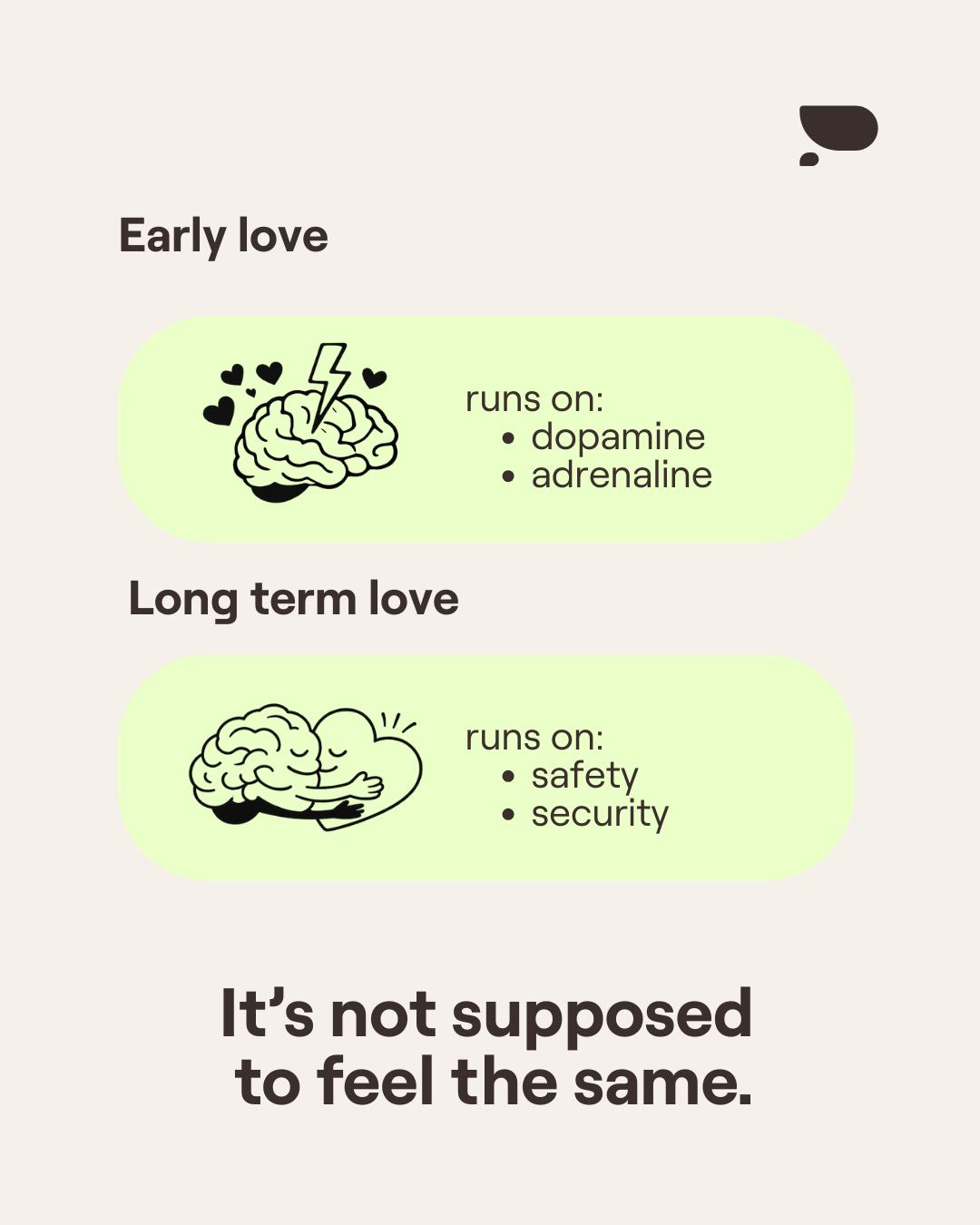
Expecting long-term love to feel like
the beginning is
biologically impossible.
Early relationships run on dopamine and adrenaline. Possibility. Uncertainty. Novelty.
Long-term relationships run on safety, attachment and nervous system regulation.
They are not meant to FEEL the same.
Because they are DOING something different.
I’m not saying we can’t still crave the spark, we just need to understand when it’s a chase for chemical intensity OR a craving for growth, maturity and deeper connection.
PS in practice
How this plays out in real relationships
A couple arrives saying, “We’ve lost the spark.”
There’s no betrayal. No crisis. Just flatness.
What’s actually happening:
Their nervous systems are stable
Their attachment bond is secure
Their dopamine system has adapted
From a neuroscience perspective, this is expected.
Dopamine fires on novelty, not familiarity. The brain conserves energy by reducing reward response to what is predictable.
Behaviourally, the danger moment comes next.
Instead of understanding the shift, one or both partners start:
Withdrawing
Picking at each other
Fantasising about someone else
Creating conflict to feel something
Gottman would call this the erosion of fondness and admiration.
Esther Perel would name it the collapse of desire under too much sameness.
What looks like “falling out of love” is often a misunderstanding of biology.
PS Perspective
Long-term love requires a shift most people resist.
Stop scanning the relationship.
Start showing up for your partner.
Connection isn’t built through big moments or constant processing. It’s built through micro behaviours, repeated over time. This is behavioural science. Small actions shape emotional safety, trust and attraction far more reliably than grand gestures ever will.
The research is clear: what you do day to day matters.
That looks like:
Turning toward instead of away
Asking questions without an agenda
Offering warmth before analysis
Making your partner feel chosen, not assessed
These micro-moments accumulate. They regulate the nervous system and rebuild connection from the ground up.
Long-term relationships carry a paradox you have to learn to hold.
Your nervous system wants safety.
Your brain still wants stimulation.
Both are true.
Esther Perel reminds us that desire needs distance, mystery and vitality, not just closeness.
Gottman shows us that trust is built through emotional safety, repair and consistency.
Most couples collapse one side of the paradox.
They turn safety into emotional dumping.
Intimacy becomes constant processing.
Their partner becomes the container for everything.
But your partner is not your parent.
They are not there only to hold your pain.
Sometimes love means regulating yourself before you connect.
Holding your own emotional weight.
Letting your partner see the version of you the world sees.
Choosing warmth over rawness on an ordinary Tuesday.
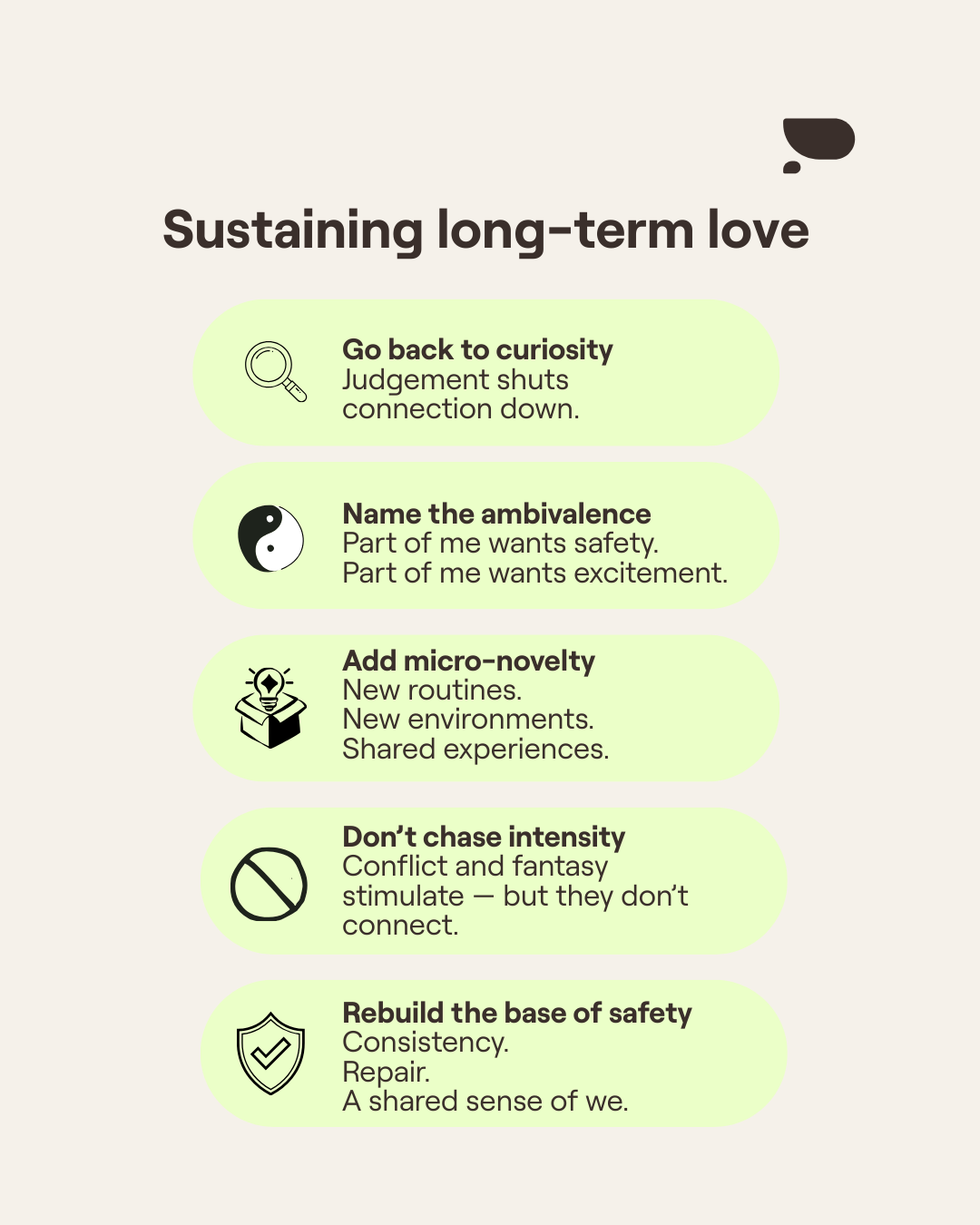
To sustain long-term love:
Go back to curiosity.
Curiosity activates connection. Judgement shuts it down. Treat your partner like someone you’re still learning.
Name the ambivalence.
Saying “Part of me wants stability and part of me wants excitement” activates the prefrontal cortex and reduces impulsive behaviour. It creates choice instead of reaction.
Add micro-novelty.
You don’t need a new partner. You need new stimulation. Change routines, environments and shared experiences. Novelty refreshes dopamine without destabilising the bond.
Don’t chase intensity.
Conflict, withdrawal and fantasy feel stimulating, but they don’t create connection. They create cycles. Hold the discomfort instead of acting it out.
Rebuild the baseline, not the high.
Long-term satisfaction comes from consistency, repair and shared meaning. That’s what stabilises the nervous system and allows desire to return.
Deep vulnerability matters.
But so does play. Lightness. Effort. Attraction.
Long-term love isn’t radical honesty all the time.
It’s discernment.
The PS Point
You don’t miss what you had.
You miss novelty.
The power of long-term love is safety, depth and being fully known.
The work is protecting desire inside security — regulating yourself, staying curious, and showing up in small, consistent ways.
In the early days, you weren’t judging the relationship.
You were curious about the person.
You showed up for them, not for “us.” This is where you need to return to.
The spark doesn’t disappear.
It just stops being automatic.
Need help reconnecting?
You don’t need a crisis to work on your relationship.
Couples counselling can help you rebuild connection before things unravel.