
Equality vs Equanimity: Why Women’s Biology Matters in Leadership, Work and Life
With International Women’s Day approaching, I find myself both celebrating how far women have come and questioning the direction we are continuing the fight.
If you’ve been reading the BULLetin for a while, this won’t surprise you. I am unequivocally pro-women. Pro-capacity. Pro-choice. Pro-power.
And I hold a view that still makes people uncomfortable.
Women are biologically different.
That difference is not a problem to solve. It is something to value.
Equality was a necessary corrective to exclusion. Women needed access, rights and opportunity. That fight mattered.
But somewhere along the way, equality became sameness. In the process, we quietly erased the very things that make women effective, intuitive and powerful.
Equality vs Equanimity: Designing for Real Humans
Equality says: be the same to be valued.
Equanimity says: be different without being disadvantaged.
Only one of these aligns with biology, neuroscience, and how humans actually function.
Equanimity doesn’t lower standards or remove accountability. It designs systems around reality.
And the reality is this: modern life — work, leadership, relationships — is still largely organised around:
stable energy availability
linear productivity
uninterrupted capacity
That model aligns neatly with male biology, which is hormonally stable across adulthood.
Female biology is not.
Women move through predictable biological transitions:
cyclical hormonal shifts
pregnancy and postpartum neurobiological change
perimenopause and menopause
caregiving load that coincides with peak career and leadership years
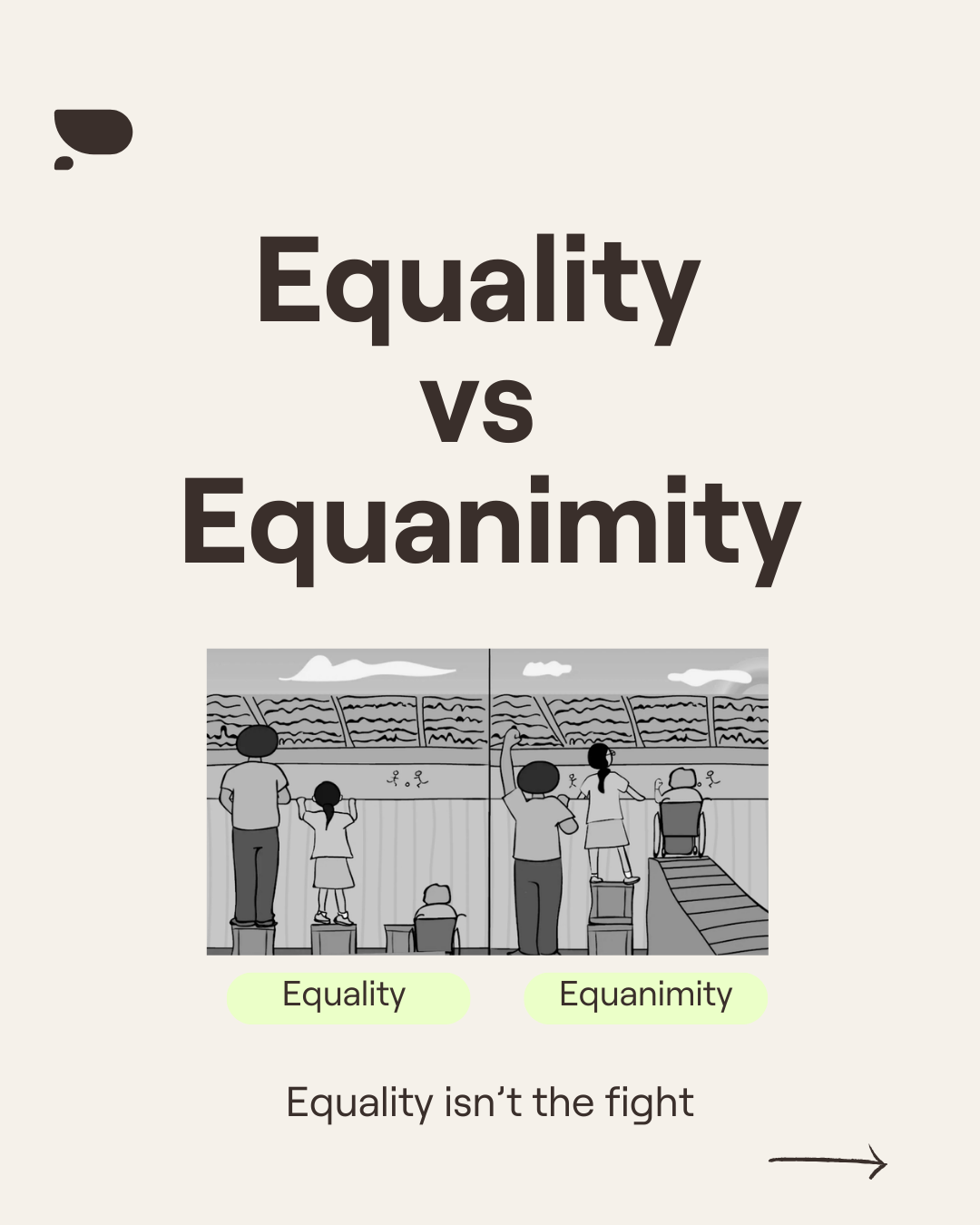
Equality says:
“You now have the same rights. Adapt.”
Equanimity asks:
“How do we build systems that sustain performance across real biological lives?”
That question changes everything.
PS Perspective
Femininity, Biology and the Cost of Sameness
In the push for equality, femininity quietly became something to minimise or neutralise, especially in leadership and professional life. Not because it lacks value, but because it does not fit systems designed around sameness.
Femininity brings real functional strengths:
relational awareness,
early detection of threat and opportunity,
responsiveness to context
ability to hold complexity without rushing to control.
These are not soft skills. They are regulatory strengths.
Neuroscience, behavioural and relational science show that men and women tend to process stress, connection and decision-making differently. Not absolutely, but reliably enough to matter.
Women, on average, show stronger relational attunement and contextual awareness. Men tend to show stronger task focus, action bias and containment under pressure.
These differences do not define individuals. But why are we fighting their ability to exist when we could be nurturing it?
When femininity is suppressed, women compensate by over-functioning and disconnecting from their bodies. The cost is exhaustion, not empowerment.
This is where the gender debate often misses the point. For the same job, same hours and same output, there is no lawful gender pay gap in Australia. Women are actually outranking men in numbers graduating University and Colleague higher education.
The divergence appears over time and tracks closely with biology: childbearing, hormonal transitions, midlife attrition and burnout reframed as “choice.”
By fighting to be treated the same as men, women have often been forced to work against their own design. Equality flattened difference. Equanimity restores balance.
The PS Point
Purpose Comes From Alignment, Not Sameness
A purposeful life is not built by overriding biology.
It is built by understanding it and working with it.
What we should be fighting for now is equanimity: the internal steadiness to be who we are, and the external conditions that allow that to function.
Women do not need to become men to be effective.
Men do not need to neutralise masculinity to be safe.
Equanimity allows women to use relational intelligence without penalty, men to bring structure and decisiveness without shame, and individuals to regulate themselves instead of suppressing or hardening themselves.
Equality opened the door.
Equanimity determines whether we build lives, relationships and careers that actually work.
If we keep waiting for external systems to define who we’re allowed to be, we’ll keep mistaking endurance for empowerment.
That isn’t progress.
Ready to stop working against your biology?
I work with women and organisations to understand their biological wiring, reconnect with intuition, and make decisions from alignment rather than performance or imitation. This is not about adopting masculine roles to be taken seriously, but about working at your highest capacity by honouring how you are designed.
If you’re ready to stop compensating and start optimising, get in touch. Together, we’ll design a way of working and living that actually works for you.